Saturday, October 23, 2010
Magical Moments
At Railway Stations. From Nanopolitan.(Did they get the idea from the last scene in Slumdog Millionnare?)

The Nobel Committee Speaks up
Thorbjorn Jagland, chairman of the Nobel Prize Committee explains why they awarded the Nobel Peace Prize to Liu Xiaobo.
Monday, October 11, 2010
The Evil Empire
It is painful to call one of the most economically successful countries in the world an evil empire. But consider this
...freedom, equality, and human rights are universal common values shared by all humankind, and that democracy, a republic, and constitutionalism constitute the basic structural framework of modern governance. A "modernization" bereft of these universal values and this basic political framework is a disastrous process that deprives humans of their rights, corrodes human nature, and destroys human dignity. Where will China head in the 21st century? Continue a "modernization" under this kind of authoritarian rule? Or recognize universal values, assimilate into the mainstream civilization, and build a democratic political system? This is a major decision that cannot be avoided.Thus speaks the apparently infamous Charter 08 penned largely by Liu Xiaobo (the 2010 Nobel peace prize winner) and signed by, by now, thousands of people. The complete text of the charter is here. It calls for more freedom and an end to single party rule in China. And for this, a document, nobody in India, Western Europe or the Americas would glance twice at for subversive ideology, the Chinese Goverment has jailed Liu Xiaobo for 11 years! Perhaps I have a small mind that cannot grasp big ideas -- but a 11 year jail sentence for penning this Charter? The perfidy and viciousness of the Chinese Government does not stop here. The New York Times reports
The wife of this year’s Nobel Peace Prize winner, Liu Xiaobo, was allowed to meet with her husband on Sunday at the prison in northeastern China where he is serving an 11-year sentence, but she was then escorted back to Beijing and placed under house arrest, a human rights group said...Even private parties are not safe
On Friday night, the police detained 20 bloggers, lawyers and academics who gathered for a celebratory banquet at a private room in a Beijing restaurant. By Sunday night, 10 guests had been released, according to a prominent activist, Zhang Zuhua, another of Charter ’08’s main authors. Three were given eight days in detention for disturbing the peace, and seven have been escorted out of Beijing, Mr. Zhang said.To me, these are the classic signs of an evil empire -- a powerful one, capable of doing great damage, to itself, to its people and eventually to the world. And yet, is China unique in this? Aren't there other countries equally intolerant of dissent? Then why does China get all the flak?
One of the favourite positions of the left liberal Indian establishment is to point out that we, or rather the Indian Governmemt is equally intolerant of dissenting opinions. They point to our practice of meeting unarmed protesters (or armed only with stones) with live ammunition, in Kashmir, the North East and elsewhere. And indeed, our policy (if indeed we have a coherent one) in this regard is seriously condemnable. But to compare Indian attitudes to dissenting opinions to the Chinese one, is to my mind, unadulterated balderdash. Government policy, not just in Kashmir but on everything from the economy to the National Rural Employment Guarantee scheme faces daily and virulent criticism, not just in the mainstream press but also in gadfly magazines like Tehelka. And while there are occasional half-hearted attempts to harass such agencies, nobody seriously tries to throttle free expression any more. Sixty three years of a free press (and a bad 2 years of emergency) has meant that dissent is firmly entrenched in the Indian psyche and a Government can only interfere with it at its own peril. Include opinions in non anonymous blogs and you see an even more extreme and at times hysterical level of criticism. I think a comparison with China is laughable and just plain odious. At the same time, strong publicly expressed public opinion has meant that frequently the Government is forced to take cognisance, whether on Kashmir or on the Right to Information Act or on the Commonwealth Games or on a hundred other subjects.
Th other issue is about China's unique position. After all, countries like Burma (Myanmar), North Korea, or even the tin-pot desert kingdoms living off their oil, aren't exactly epitomes of democratic governance. In fact to my mind, they are worse. China today has made enormous progress, in eliminating poverty, improving education and the material wealth of its people, in its infrastructure. Its economy is a challenge to the rest of the world, which is beating a path to its door, to do business with it. And that is what makes China so much more dangerous, than those countries I mention above. In their need to do business with China, virtually all countries from the US to India are willing to overlook China's by now abysmal record of human rights. China has the potential for setting the agenda with other countries, on its own terms, and that bodes ill for the future.
Update: If you think I am prejudiced about China, maybe this Op-Ed by Paul Krugman will convince you. He is talking of the Japan China 'tiff' but the idea is the same. If I am prejudiced, then at least I am in good company.
Update 2: The Pakistan Government has come out in strong support of the Chinese position on the Nobel Prize. How does the Government of Pakistan manage to be on the wrong side every instance? And amusingly, the only Indian newspaper to report on this is the Hindu :-)
Sunday, October 10, 2010
Toilet Training
Now that the noise (and noise it was) about our (un)preparedness for the Commonwealth Games has gone down, with news desks even predicting sone ki bauchar (rain of gold (medals)), I want to come back to a statement Lalit Bhanot, the Organising Committee spokesperson made, implying that Indian hygiene levels were in some sense inferior to those of Westerners. The wrath of a million or more Indians descended on his head, with Salman Rushdie, whose ghost permanently hangs around the Gateway of India, suggesting that he be spanked. Even the venerable New York Times which usually ignores all games where the US is not involved felt called upon to comment on it.
I would like to take a somewhat different perspective on this issue. I don't mean to imply that Indians are generally less hygiene conscious -- far from it -- though it is true that we have double standards as far as private and public cleanliness issues go. A person who would not dream of leaving even a shred of paper on his floor in his own house, will willingly sweep all the detritus out on the road and sometimes in front of his neighbour's house, or throw garbage on the road without thinking twice. Homes in India are regularly swept and swabbed daily (sometimes twice!), bathrooms are cleaned with gallons of water being poured all over. Most Indians in fact have a holier than thou approach towards these issues, particularly with regard to the West. We use water, they use toilet paper, how clean is that? -- is the common refrain. (Some Indians, after a stint in the West take to the Western way, considering it to be somewhat less messy. I even know a colleague who claims they have toilet trained their child to use water in Indian toilets and paper in Western toilet -- I think I am missing something here...).
But to return to my point. While the Bhanot statement was frankly stupid, there is an element of truth in it. Most Indian bathrooms, except the more modern ones, and despite the use of liberal quantities of water, would not appear clean to a Western eye. And the reason is precisely the use of water -- or rather the difference between a dry and a wet bathroom. Western bathrooms have a separate area (usually on one side) for a bath/shower. The rest of the bathroom is dry, and frequently does not even have a water outlet. In India, essentially the whole bathroom is a 'wet' area. A full scale bath/shower/bucket wash involves the liberal splashing of water in all directions, making the whole bathroom wet. (This is not helped by the fact that most Indian bathrooms are designed to have a bath area in the centre rather than a shielded off area to one side). The net result of all this is a generally higher humidity level causing mold and fungus to grow around cracks and crevices, to say nothing of water stains from the use of hard water. Most of these are tough to clean or even to prevent. Moreover, old Indian bathrooms had cement floors which are impossible to keep clean. In fact, this is the main reason why people are always asked to take off their shoes before entering a bathroom -- the danger of leaving muddy footprints, which would never happen if the bathroom were kept dry in the first place.
Overall, the idea of a dry bathroom is contrary to the Indian concept of a bathroom where liberal usage of water is considered the norm. Fortunately this is changing albeit slowly, and modern apartments do try and keep a separate area for a shower complete with shower curtain.
None of this excuses the fact that our use of public facilities is totally atrocious. We believe we have almost a right to pollute any and every public space -- assuming that there is always 'someone' to clean up after us. I am of the firm view that this attitude harks back to our old caste system. There always was someone to clean up after us, at least for the upper classes, and we continue in that mode. Which suggests that it will be a long time before these attitudes change.
Wednesday, September 29, 2010
Bt Egg(plant) on the Face
Much has already been written about the Bt brinjal report fiasco by six of India's National Academies. If you don't know what I am talking about Nanopolitan has a nice summary including all relevant links. Yesterday one of the many distinguished fellows of INSA received a 'mea culpa' mail from the President of INSA. I am not at liberty to quote it since I was only shown it informally but the mail, if anything, makes things worse and carries traces of the same sloppy work of the main report.
To begin with, it even misspells the name of the Minister of Environment Jairam Ramesh as Jayaram Ramesh. You would think Jairam Ramesh has been in the news long enough for his spelling to register in most people's mind. Secondly after much talk about how this was the first attempt to bring six academies together (as if six academies together should be excused for sloppiness but one shouldn't), it actually admits that they could have done a better job and that the present report should be withdrawn and re-written. However, and this is interesting, the 'baby should not be thrown out with the bath water' meaning I suppose most of the conclusions should stand. I wonder why that should be so, since it also turns out that this is not an independent report but a rehashed version of a report by one Anand Kumar. Why should be assume that a genuine independent study by the academies would throw up the same conclusions?
The second interesting point is that the President of INSA chooses to present his defense to what might be called his biradari -- the fellows of the academy. Should not this mail have gone to the public in general and specifically to the media which mounted this campaign along with an advocacy group against GM crops. Why keep the justification within the family -- what purpose does it serve? Of course, one does not know if the President of the other academies have even sent a letter justifying a stand or they just hope if they wait this out, it will all blow over.
This is not an isolated incident. Many people will recall the episode of the Mashelkar report and accusations of plagiarism. Why do these things happen?
I really don't believe that these scientists are mediocre or are plagiarists -- far from it. Both the Presidents of INSA and IAS (Bangalore) are very distinguished scientists. However, there is a tendency in India to pass off work to a low level flunky, particularly if it is considered not so important (and definitely not a paper one is writing for a reputed journal). I suspect this is what has happened here too. The work was probably palmed off to some low level functionaries who used that well known research tool 'Google' to do their 'research'. The top bosses glanced cursorily at the result (surprisingly not noticing that a cornerstone of research papers -- proper referencing -- was non existent). There was, in other words, no serious oversight, no proper attribution, and yet, the heads of the academies were willing to put their reputation on the line by putting their names on the report. They presumably assumed that the report would just end up in some dusty cupboard in some government office never to see the light of day. Instead of which, it landed on the table of one of our most pro-active ministers!
Just as a comparison, here is the report on global warming by the American Physical Society. Click on the link to get the PDF version of the full report.
P.S. Just learnt from Nanopolitan again that the National Academy of Medical Sciences has dumped the report! Hmm....a case of rats deserting a sinking ship? Wonder what else will unfold in the next few days....
P.P.S.: Here is the letter of the President of INSA to the Fellows of the Academy, complete with misspelt name and all (courtesy a colleague).
P.P.P.S.: See also a recent letter by Gautam Menon and Rahul Siddharthan on this issue.
Tuesday, September 21, 2010
Speaking Paper
This morning the venerable Hindu newspaper arrived, complete with an implanted chip on the back page that, in a disembodied voice, extolled the virtues of the Volkswagen Vento . Hapless souls like us who also subscribe to the Times of India, got the effect in stereo. Interesting, it would stop on closing the newspaper. Since we had two samples, I tore off one and here is what it looks like from the outside
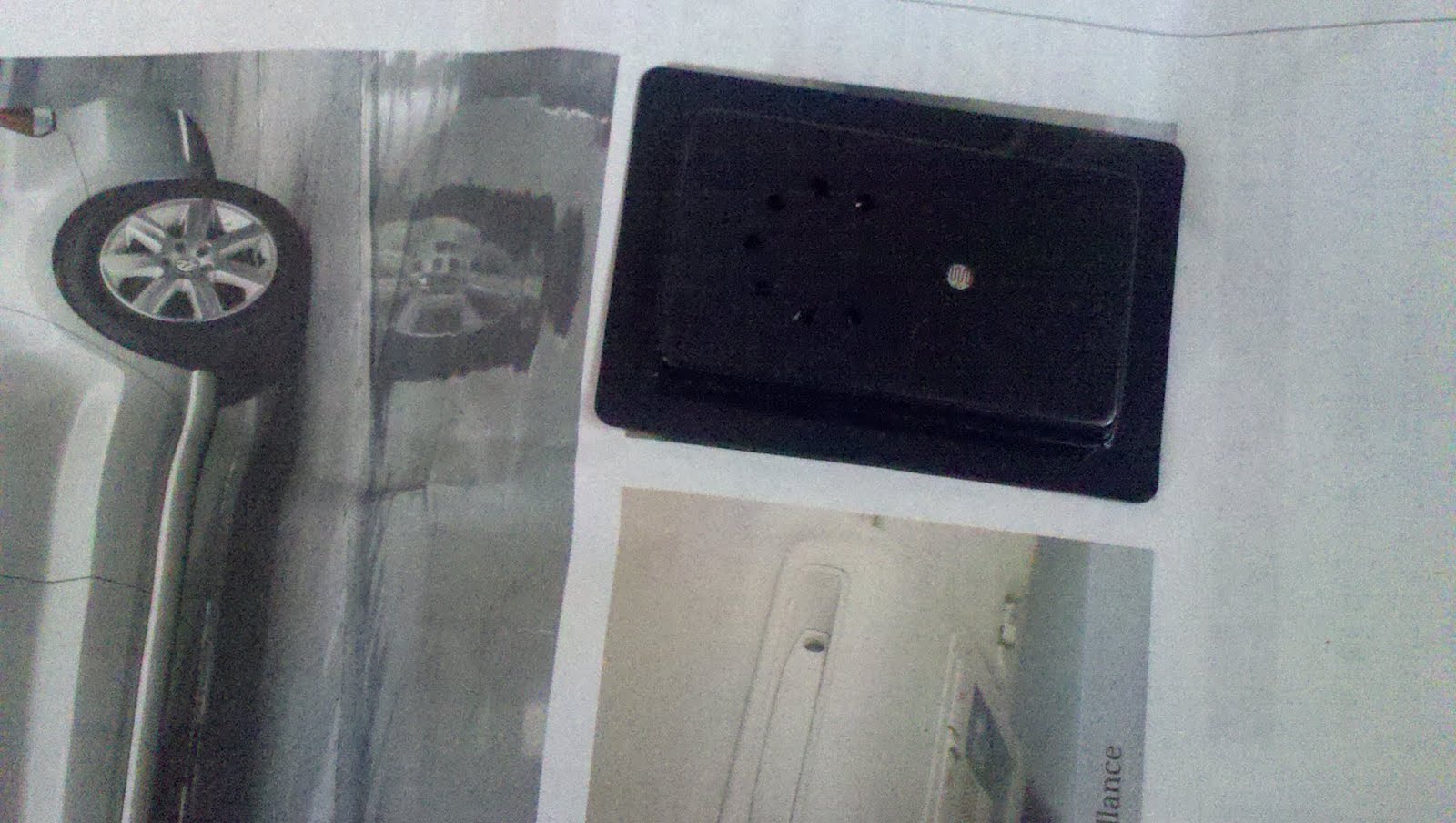
And here is what it looks like on the inside, on tearing it off the page

No big surprise there -- a small chip with batteries and a small speaker. Apart from the sheer irritatingly repetitive yammering which is not going to win the Volkswagen Vento any friends, I got to wondering if this was going to be the wave of the future.
For example, one could think of the whole daily newspaper converted to audio and arriving with an implanted chip which would read out the news. This could be a boon to the visually impaired. Of course one can do the same I presume with the on line versions of newspapers but that involves having a computer, an internet connection, and other such paraphernalia. This, on the other hand, could be as easy as picking up the paper from your doorstep and then just listening to it. In its present form, you would have to listen to the whole newspaper which is a pain, since there are no user controlled functions on this object. But those could eventually come.
Small sound producing chips aren't new by any means. In the 80s I recall sending friends and relatives, from the US, greeting cards which played a song when you opened it, much to the excitement and amusement of the recipients. Compared to those, this one is surprisingly bigger in size. Also the cost of such an object, even though small, can hardly be included in the price of the newspapers, which typically are Rs. 3 to Rs. 5. So it would have to be ad revenue supported. But in today's world of the internet, SMS, cell networks, is there a genuine place for such a product? Are there some innovative uses one could put such a device to, other than the single one I mentioned above?
Saturday, September 18, 2010
Teppanyaki Juggling
A new restaurant has recently opened in Chennai called Teppanyaki as an addition to the old Thai restaurant Benjarong on TTK Road. Teppanyaki, as Wikipedia informs us stands for teppan (iron plate) and yaki (grill) and is a style of Japanese cooking which grills and stir fries on an iron griddle. It is usually done in front of the diners so that the chef can show off his prowess. Most of the food is of the stir fried style, but produced with great style and elan.
So here is our chef warming up, throwing his weapons around with great abandon, and rather worryingly, missing occasionally. (I apologise for the poor quality -- the light was insufficient, and I also couldn't find a way to turn some of the videos around).
Some tricks with a bowl
And then with eggs. Watch carefully how they land on his spatula and yet don't break - though there are a couple of mishaps as you can see. Can you figure why the eggs don't break despite landing on a solid steel spatula? (you will need to turn your head to see this video).
And finally, here is a generic one of him doing the actual cooking.
A set menu (soup, salad, main course, which is the teppanyaki, noodles/rice and a dessert bar) costs around Rs. 950 to Rs 1150 depending on which set you choose. There is also a la carte which will probably set you back a similar amount, though without as many items, but with more choice.
Overall an interesting experience, though regrettably the food gets a B. But that probably has something to do with it being Chennai :-(. The one in Hip Asia (Connemara) is better.
Subscribe to:
Posts (Atom)

